


The wait is finally over. Spain and Argentina face off in New Jersey today to determine who will be crowned world champions. This final between the tournament’s two most consistent and strongest sides is not just a battle between two countries — it’s a showcase of footballing strategy at its finest. But the real beauty of this final lies in team chemistry.
On one side, Spain function like a perfect, disciplined engine. Every player in La Roja’s squad knows their role intimately and fights to the last for the collective good of the team. Spain may lack a single standout superstar, but their selflessness and technical precision leave opponents helpless.
On the other side, in Atlanta, Argentina showed their trademark fighting spirit. Despite falling behind early against an aggressive England side, the Albiceleste won the match with an epic last-minute comeback — orchestrated by Lionel Messi himself. His two magical assists not only united the team but reignited an entire nation.
So who will lift the trophy? Will Spain add a World Cup star to the crown they won at the Euros two years ago? Or will Argentina become the first team since Brazil in 1962 to win back-to-back World Cups? Whoever wins on the pitch, several key individual duels are likely to shape the outcome of this great battle in New Jersey.
1. Midfield epic: Rodri vs. Enzo Fernández and Mac Allister
Throughout this World Cup, there’s been a quiet consensus among football fans that only Spain managed to shut down France’s pace in the semi-final — and that was possible largely because Rodri stood like a vigilant sentinel in front of the Spanish defense. The Manchester City star has battled plenty of injuries over the past two years, but the way the Ballon d’Or winner delivered a midfield masterclass against France makes clear he’s back to his very best.
Argentina’s engine room certainly isn’t short on aggression or physicality. The Albiceleste have every tool needed to disrupt La Roja’s ferocious attack, but the job falls squarely on Enzo Fernández and Alexis Mac Allister. This pair cannot afford to give Rodri even a moment of time or space on the ball — because if he gets it, he’ll dictate the entire match, just as he did in the semi-final.
The good news for Argentina is that Enzo and Mac Allister aren’t just capable of shutting Rodri down — they also have the ability to unsettle the partnership between Rodri and his midfield partner, Fabián Ruiz.
Enzo Fernández hasn’t been at his sharpest in every match this World Cup, but his crucial goals against Egypt and England proved just how dangerous he can be on the big stage. Meanwhile, the story of the semi-final could have been very different had two of Mac Allister’s shots against England not struck the post in the final minute. With both heroes of Qatar 2022 rediscovering their best form just ahead of the final, it’s a huge relief for Lionel Scaloni.
2. Cold war between the posts: Unai Simón vs. Emiliano Martínez
Looking purely at clean-sheet statistics from this World Cup, Spain’s goalkeeper is far ahead of his Argentine counterpart. Unai Simón has conceded just one goal across the entire tournament, while Argentina’s net has been breached seven times — Emiliano Martínez has failed to keep a clean sheet in every match except the group-stage win over Austria.
Still, when it comes to potential impact in the final, Martínez may hold the edge. Love him or hate him, the Argentine possesses an uncanny ability to unsettle opponents through remarkable shot-stopping and psychological gamesmanship.
Spain’s Simón, by contrast, prefers to operate quietly — perhaps why he remains somewhat underrated. It’s also true that Spain’s defense has been so solid throughout the tournament that Simón has faced relatively few difficult tests. While the statistics favor him, some Spain fans themselves argue that Barcelona’s Joan García or Arsenal’s David Raya are technically superior to Simón.
That said, Argentina’s attack — which has broken through even the most solid defensive walls this tournament — is likely to give Simón the toughest test of his career in New Jersey. How he responds remains to be seen.
3. Unsung goal-scorers: Mikel Oyarzabal vs. Julián Álvarez (or Lautaro Martínez)
It may not be a direct positional battle, but Mikel Oyarzabal and Julián Álvarez play nearly identical roles for their respective sides — and the final may well hinge on which of the two proves more effective.
Oyarzabal has quietly been Spain’s unsung hero throughout this World Cup. Despite being in excellent form for club and country, he flew somewhat under the radar early in the tournament — but his braces against Saudi Arabia and Austria have added a new dimension to Spain’s attack.
Argentina’s Julián Álvarez, meanwhile, hasn’t quite lived up to expectations. His sluggish form is understandable given an early-tournament injury, but his spectacular goal against Switzerland served as a reminder of just how dangerous he can be given a bit of time and space.
Even so, Lionel Scaloni faces a real dilemma ahead of the final. Lautaro Martínez’s winning header off the bench against England has given the Albiceleste camp fresh hope, and there’s likely to be strong pressure to drop the out-of-form Álvarez in favor of restoring Martínez to the starting XI.
4. The magician vs. the Spanish wall: Lionel Messi vs. Marc Cucurella
Lionel Messi certainly won’t be playing as a conventional winger in the final. But at 39, he’s proven at this World Cup that he remains one of the best wide players in the world, operating effectively on either flank. He may no longer possess the blistering speed he once had with the ball at his feet, but his trademark dribbling — capable of beating any full-back or delivering a precise cross into the box — hasn’t diminished in the slightest.
Goalkeeper Emiliano Martínez has confirmed that Argentina’s crucial wins over Egypt and England came after Scaloni shifted Messi to the right wing. That means Marc Cucurella will need to be more alert than any other Spanish defender in New Jersey, as Messi is likely to repeatedly drift right throughout the match to exploit Cucurella’s zone.
But there’s a flip side to this matchup. Messi rarely tracks back defensively, and his tendency to stay forward could be exploited by the highly attack-minded Cucurella. Indeed, Cucurella’s overlapping runs and constant forward surges have been one of Spain’s greatest strengths on their run to the final.
Naturally, Scaloni is expected to assign special defensive responsibilities to his right-sided player — either Rodrigo De Paul or the equally combative Giuliano Simeone — tasked with limiting Cucurella’s forward forays and keeping him occupied defensively, thereby freeing up space and time for Messi to work his magic.
5. Youthful energy vs. a wall of experience: Lamine Yamal vs. Nicolás Tagliafico
Lamine Yamal’s full potential hasn’t quite been on display at this World Cup — at least, not yet. But the 19-year-old Barcelona winger has flashed glimpses of his extraordinary dribbling at times. After Spain’s shock draw with Cape Verde, he came off the bench against Saudi Arabia and scored the opener that got their campaign back on track.
Yamal himself has admitted he hasn’t fully lived up to the sky-high standards he set for himself this tournament, citing injuries and the intense mental pressure of needing to “prove himself.”
Crucially, though, his confidence has never wavered — he’s maintained a firm belief throughout that his best form would emerge when it mattered most. The final could be exactly that moment, because on paper, Yamal vs. Tagliafico looks like a distinctly uneven contest.
The 33-year-old Argentine left-back brings a wealth of experience, having earned 76 caps for his country. He famously shut down Ousmane Dembélé so effectively in the 2022 World Cup final that Didier Deschamps was forced to substitute the French winger before halftime.
But regardless of any struggles with rhythm or fitness, the Yamal of 2026 is a fundamentally different player from the Dembélé of 2022. If Tagliafico — a veteran with French club Lyon — doesn’t receive solid support from Enzo Fernández in midfield or Lisandro Martínez on that flank, his defense could simply be swept aside by Yamal’s speed and dribbling down the right.
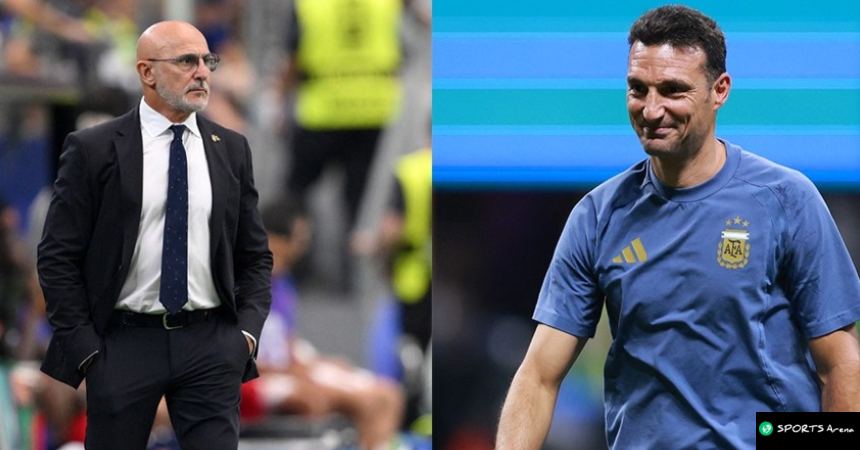
6. Dugout chess: Luis de la Fuente vs. Lionel Scaloni
However thrilling the on-field battle between the 22 players proves to be, the outcome of the final may ultimately come down to the tactical decisions made by the two coaches in the dugouts — Spain’s Luis de la Fuente and Argentina’s Lionel Scaloni, each facing very different challenges.
De la Fuente made a puzzling choice in the tournament opener by fielding Gavi on the right wing — a decision that surprised critics and fans alike and looked, in hindsight, like a slightly desperate move. But he quickly corrected course, and virtually every decision since has been vindicated. The fact that Spain sit in today’s final, having won six consecutive matches inside 90 minutes, is largely down to his management.
Mikel Merino has occasionally had to bail Spain out late in matches, but that’s mostly a testament to how motivated and hungry every player in De la Fuente’s squad remains. He’s also earned praise for his bold call to bench Barcelona star Pedri in favor of Fabián Ruiz — a decision Ruiz has repaid in every match, whether scoring the opener against Belgium in the quarter-final or anchoring midfield alongside Rodri against France.
Lionel Scaloni, meanwhile, earned plenty of praise for his game-changing substitutions in the semi-final against England. Still, his decisions had reportedly come under scrutiny within the Argentina camp in the lead-up to that match.
The team looked overly reliant on Messi during the group stage, and even in fortunate, inconsistent wins over Cape Verde, Egypt, and Switzerland, Argentina’s midfield chemistry never quite clicked.
With that in mind, Scaloni has plenty to think about ahead of the final. De la Fuente now commands a well-organized, balanced, and in-form side that played some of the tournament’s most complete football against France. That puts real psychological pressure on Scaloni to get his approach right from the opening whistle — because while Messi remains a miracle worker and Argentina’s capacity for comebacks is remarkable, falling behind against such a disciplined Spanish side in a final could prove impossible to reverse.