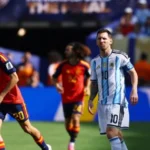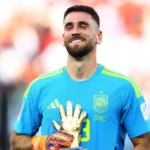





Ten years ago, Messi announced his retirement from international football after losing the Copa América final to Chile. Fans and supporters had long dreamed of seeing Argentina triumph on the world stage once he reversed that decision, and the stage at MetLife Stadium seemed set for that moment to arrive. Before kick-off, 1978 World Cup-winning Argentina captain Mario Kempes held the golden trophy aloft to inspire Messi and his teammates ahead of the 2026 World Cup final. With a record-breaking run to the final, all eyes and all the spotlight were on Messi. Had Argentina won, they would have joined Italy (1934 and 1938) and Brazil (1958 and 1962) as the only nations to win the World Cup in consecutive tournaments. Supporters were eagerly anticipating a repeat of 2022, with Messi once again raising the golden trophy. However, before kick-off, the sight of Spanish legend Andrés Iniesta — a symbol of Spain’s footballing renaissance — holding the trophy aloft fired up the new generation of Spanish players with equal determination.
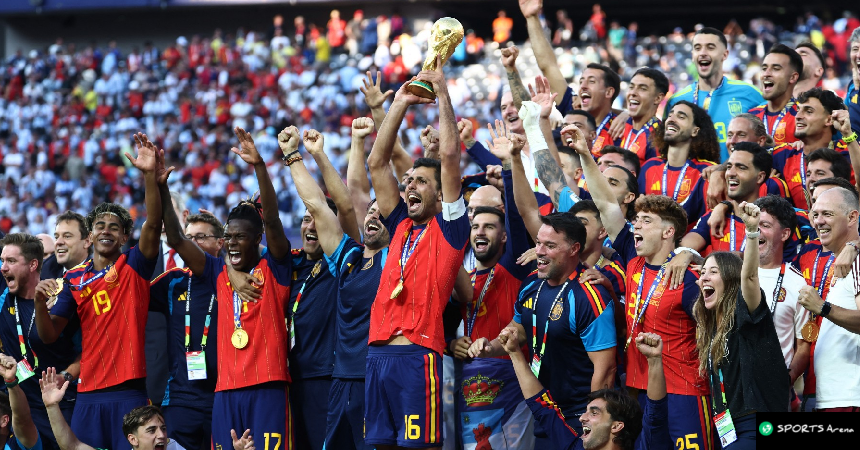
Spain frustrated Argentina’s defensive approach and capitalised on a series of sustained attacks throughout the match. They reclaimed the World Cup trophy for the first time in 16 years with a goal from Ferran Torres in the 116th minute of extra time, winning 1-0.
Spain’s coach Luis de la Fuente succeeded in his primary objective — keeping Messi, who had been the driving force behind Argentina’s every victory in this tournament, quiet and ineffective throughout the match. Having spent the majority of his playing career in La Liga, Messi is a familiar figure to the Spanish football world, and De la Fuente and his players knew his game intimately. Spain’s defence was entirely successful in neutralising the Argentine captain.
Playing in a 4-4-2 formation, Argentina’s two forwards — Messi and Julián Álvarez — were largely anonymous from the outset, subdued by Spain’s tight and disciplined marking. Despite the presence of a strongly pro-Argentina crowd, Spain controlled the game from start to finish. Remarkably, Spain dominated possession with 65 percent of the ball across 120 minutes of football. Even more strikingly, Argentina failed to register a single shot on target against Spain’s goal, while Spain had 12 attempts on target.
Spain, operating in their familiar 4-2-3-1 formation, produced their trademark tiki-taka football throughout the match, wearing down their opponents through relentless ball retention and crisp one-touch passing. Argentina managed only 358 passes in total compared to Spain’s 762 — a statistic that speaks volumes about the one-sided nature of the contest.
Spain created two dangerous opportunities in the first half. In the fifth minute, winger Lamine Yamal made a penetrating run into the penalty area and laid the ball off to midfielder Dani Olmo, who returned it to Yamal with a neat one-two. Yamal brought the ball under control, but the combined efforts of Lisandro Martínez and goalkeeper Emiliano Martínez kept Argentina out of danger.
In the 39th minute, another well-constructed Spanish move threatened to open the scoring. A slick combination between Laporte, Rodri, and Baena saw Fabián Ruiz play in Mikel Oyarzabal, who had made a well-timed run into the box. Oyarzabal struck a powerful left-footed effort from the corner of the area, but Emiliano Martínez produced an excellent save with his feet to keep the scoreline level.
Messi managed only 15 touches of the ball in the first half, though he did create one promising opportunity just before the hydration break. In the 22nd minute, the Argentina captain played a beautifully weighted ball to Nicolás González on the edge of the box, but González failed to bring it under control and the chance was wasted.
The world was treated to flashes of brilliance from Yamal — the young star whom Messi had famously held as a baby 19 years ago. Yamal was a constant menace, repeatedly threatening the Argentine goal and registering 86 touches of the ball across the match.
Argentina could not find a way through the defensive wall formed by Cubarsí, Porro, and Laporte in the first half. Spain’s industrious left-back Marc Cucurella made repeated overlapping runs down the left flank, providing an additional attacking dimension while also fulfilling his defensive duties.
Spain continued to control the game after the hydration break in the second half. Argentina, having abandoned their own attacking instincts, retreated deeper and focused almost entirely on defending. Even so, Spain’s attack continued to trouble them repeatedly. In the 64th minute, Pedri played a precise pass to Olmo in the corner of the box, whose powerful shot was blocked by Emiliano Martínez, with the rebound going out for a corner.
In the 77th minute, Pedri had an opportunity to score from a cross, but his effort was comfortably gathered by Emiliano Martínez. In the following minute, Yamal burst forward but was blocked by Argentine defender Facundo Medina — though Medina failed to fully clear the danger. Cubarsí struck a powerful effort from the return ball, but Emiliano Martínez once again got in the way, conceding a corner.
In the third minute of injury time, Enzo Fernández collided with Cubarsí while competing for a loose ball and was forced to leave the field immediately. Having already received a yellow card earlier in the match, the referee showed him a second yellow — which automatically meant a red card — reducing Argentina to ten men.
In the sixth minute of injury time, Spain’s Yamal struck a free kick from approximately 25 yards out, but Emiliano Martínez leapt to his left to push it away for a corner.
Spain benefited greatly from their substitutions. The introductions of Ferran Torres for Oyarzabal, Nico Williams for Alejandro Balde, and Mikel Merino for Dani Olmo all added fresh attacking energy and sharpened Spain’s cutting edge.
Playing against ten-man Argentina, Spain turned up the pressure. In the 93rd minute, substitute Williams delivered an excellent cross into the box from Pedri’s pass, but Emiliano Martínez leapt brilliantly to keep it out. In the 96th minute, Williams found the net, but the referee disallowed the goal for a foul on Nicolás Otamendi in the penalty area.
Spain finally got the goal their dominance deserved at the start of the second period of extra time. Just 37 seconds after the restart, Spain launched a swift attack down the right flank at MetLife Stadium. Williams controlled a cross from Porro and laid the ball back to Ferran Torres, who struck a powerful shot into the net to put Spain 1-0 up and set them on course for World Cup glory for the first time in 16 years.
Argentina fashioned only one genuine goal-scoring opportunity across the entire match, and it came in the final minute. Giovanni Simeone’s header from Messi’s corner kick went over the crossbar, meaning the match did not require a penalty shoot-out.
Emiliano Martínez made 11 saves across the 90 minutes — equalling the joint record for the most saves by a goalkeeper in a World Cup final since 1966. Spain’s Lamine Yamal set a new record for the most successful dribbles completed in a World Cup final, surpassing Messi’s record of seven dribbles set in the 2014 final. Yamal completed more than five successful dribbles in 90 minutes. With this remarkable achievement, a new chapter in Spanish football’s fairy tale has begun.