

Argentine football legend Lionel Messi is widely regarded as one of the greatest footballers of all time, having enjoyed one of the most celebrated and decorated careers in the history of the sport.
Throughout his long career, the Argentina number 10 has maintained a reserved public image, rarely commenting on politics or involving himself in major public controversies.
However, the 39-year-old has occasionally come into the spotlight for his connections to Jewish initiatives and Israeli companies. At times, his name has also been unintentionally drawn into political tensions in the Middle East. During the Hamas attack on October 7, 2023, an elderly Argentine-born woman claimed she was spared by mentioning Messi’s name to one of her attackers.
In the lead-up to the Argentina-Switzerland quarter-final at the current World Cup, some anti-Israel groups highlighted Messi’s past associations and framed opposition to Argentina as an anti-Zionist stance. On the other hand, many Israelis have expressed support for Argentina and Messi.
Ahead of the match, Israeli media outlet The Times of Israel compiled ten incidents from Messi’s career in which he or his popularity has been linked in some way to Jewish and Israeli culture.
The Maccabi Games
Messi sent a congratulatory message to the Argentine team participating in the Maccabi Games held in Israel in July 2013 — a competition often referred to as the Jewish Olympics.
This was not his first such gesture. In 2011, he had participated in a campaign demanding justice in memory of the 85 people killed in the 1994 bombing of the AMIA Jewish Community Centre in Buenos Aires.
The Western Wall Visit
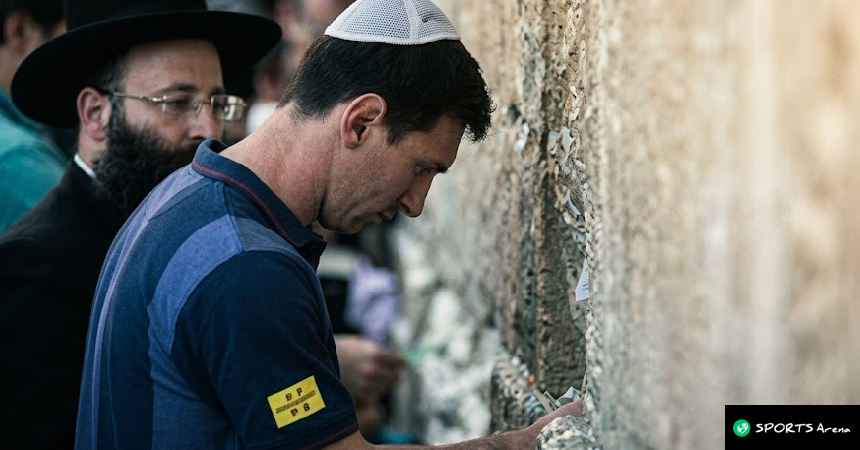
In August 2013, Messi toured Israel and Palestine with his then-club Barcelona. During the visit, he went to the Western Wall in Jerusalem and placed his prayer notes in a crevice in the wall — a Jewish tradition.
During the trip, Barcelona also ran a football training programme for Israeli and Palestinian children. The team met with then-Mayor of Jerusalem Nir Barkat, President Shimon Peres and Prime Minister Benjamin Netanyahu.
The Peace Match
In September 2014, Messi supported a Match for Peace organised in Rome by Pope Francis, intended to send a message of reconciliation between Israelis and Palestinians. He was unable to participate due to injury, but the match featured stars from Russia, Cameroon, Italy, France and Brazil, as well as Diego Maradona and Israeli footballer Yossi Benayoun.
The Unwanted Donation
After Messi donated his football boots to an Egyptian charity in 2016, several Egyptian officials criticised him, labelling him a “Jew” and a “Zionist.” Azmi Mogahed, the then spokesman of the Egyptian Football Federation, said on a television programme, “I know he is Jewish. He helped Israel and visited the Western Wall. We do not need his shoes. The poor people of Egypt do not need the help of any Jewish or Zionist citizen.”
Match Cancelled Under BDS Pressure
Argentina cancelled a friendly match against Israel in June 2018, reportedly under pressure from the Boycott, Divestment and Sanctions (BDS) movement, which campaigned under the slogan “Argentina, don’t go.” The Israeli embassy in Buenos Aires stated that the match was cancelled out of solidarity by Messi’s teammates following threats made against him.
Threats to Burn Jerseys
Two months later, FIFA banned Jibril Rajoub, head of the Palestinian Football Association, for one year. Rajoub had called on supporters to burn pictures and jerseys of Messi and Argentina if they travelled to play in Israel.
Friendly Match in Tel Aviv
In 2019, Argentina announced a friendly match against Uruguay in Tel Aviv. The BDS movement opposed the fixture once again, with protests held outside Argentina’s training camp in Barcelona. Despite the opposition, the match went ahead as planned. Messi scored in front of a capacity crowd of 29,000 at Bloomfield Stadium, including then-President of Israel Reuven Rivlin. Messi subsequently appeared in Israel twice more with Paris Saint-Germain in 2022, in both cases facing Maccabi Haifa.
Brand Ambassador for Israeli Company
In 2020, Messi became the brand ambassador for OrCam, an Israeli company that develops assistive technology for the visually impaired, signing a three-year deal. He had previously served as a global ambassador for Sirin Labs, a Tel Aviv-based technology company, in 2017.
Messi’s Name Saves a Life
During the Hamas attack on October 7, 2023, a 90-year-old woman named Esther Cuneo claimed she avoided being taken hostage by mentioning Messi’s name to one of the attackers. When the gunman approached her, she asked whether he liked football and told him she came from Messi’s country. The attacker reportedly took a photograph with her and left her unharmed. She later also reportedly sought Messi’s help in securing the release of her grandson.
Jewish Lobby Allegations
Following Argentina’s 3-0 victory over Algeria — in which Messi scored a hat-trick — an Algerian television analyst alleged that a so-called Jewish lobby had influenced the match officials’ decisions. Analyst Mustafa Mazzuzi claimed, “Messi is being protected by the Jewish lobby. This lobby controls the whole world. They run everything like the mafia. FIFA President Infantino does not want us to do well.” His remarks were widely condemned.
Meanwhile, a Palestinian TikTok creator with more than 350,000 followers called on followers to oppose Argentina at the World Cup because of Messi’s various perceived ties to Israel.
Messi’s Name in Hebrew Education
In 2020, the World Zionist Organisation used a play on Messi’s name in a Hebrew language teaching video. The video pointed out that the Hebrew word “Mesibah” — meaning festival or party — sounds similar to “Messi va” in Spanish, loosely translating as “wherever Messi goes, there will be a party.”