



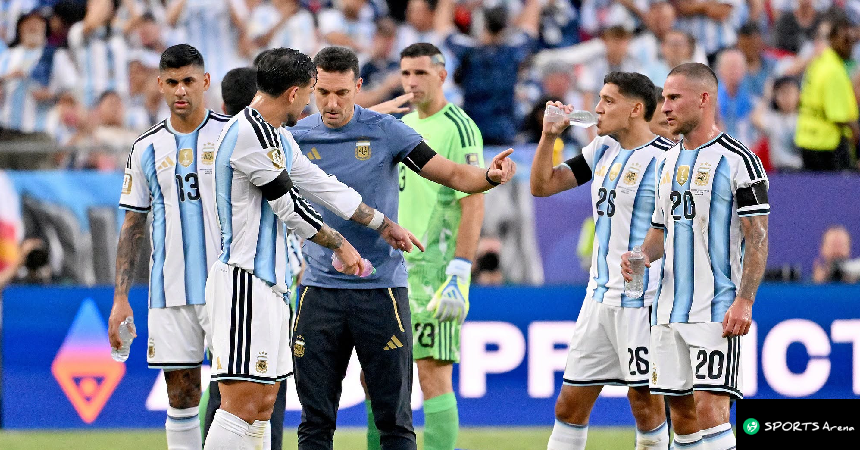
The hydration break during the fourth quarter-final of the World Cup between Argentina and Switzerland gave Lionel Scaloni a valuable opportunity to refine his tactical approach. It was during this break that the coach and Leandro Paredes had an intensive tactical discussion that went viral on social media in the hours following Argentina’s victory.
The conversation, which involved adjustments to player movement and the correction of positional errors, was published with subtitles on an Instagram account and quickly spread across football fan communities worldwide.
Paredes’ instructions centered on coordinating a specific movement in the game. Speaking to Scaloni, the midfielder explained that Switzerland’s central defender was pushing forward along the right flank. When Paredes moved to cover that area, he was losing control of the midfield, where he noted Switzerland had only one striker — but he was not referring to Embolo. Rather, he was pointing to attacking midfielder Fabian Rieder, who was operating just behind the forward line in a more advanced position.
At one point in the conversation, Scaloni told him not to mark anyone other than the player assigned to him. But Paredes pushed back, insisting that one of the opposition’s midfield players was being left completely unmarked.
At the end of the 29-second exchange, Scaloni asked whether he needed an additional centre-back. Paredes nodded and held his ground. The coach concluded the discussion by saying, “Well, then we’re bringing him — Nicolás Otamendi — on.”
The complication in implementing this change was that Switzerland had already been reduced to 10 men following Breel Embolo’s red card and had dropped into a low defensive block. As a result, Otamendi, River Plate’s experienced defender, only came on as a substitute for Cristian “Cuti” Romero in the second half of extra time.
Regardless of the tactical timing, the exchange is a fascinating window into how Scaloni operates. The Argentina coach listened carefully to the feelings and on-field reading of one of his most experienced players and made decisions accordingly — a reminder that at the highest level, football strategy is a two-way conversation between coach and player, and that flexibility to adapt the game plan mid-match can prove decisive.