

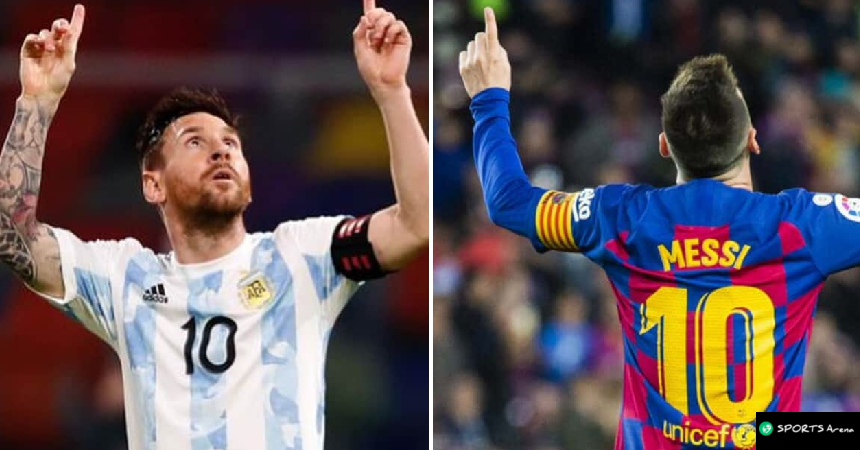
As the Spain-Argentina final approaches, Catalonia — the independence-seeking region in northeastern Spain — finds itself in a strange psychological state. Who will the people of Barcelona support in this epic battle? Luis de la Fuente’s Spain side is packed with Barça stars; Lamine Yamal, raised in the blood of La Masia, is now one of Spain’s main driving forces. Yet in another corner of the Catalan heart, the name Lionel Messi rings even louder. The Catalans’ long-standing political and geographical distance from the Spanish state has only deepened their fervent devotion to Messi.
The teenager who arrived in Barcelona at 13 with nothing but a dream had, by the time he left Camp Nou at 34, established himself as the greatest “football god” in the club’s history. Messi’s footballing childhood and youth are woven into the fabric of Catalonia. So today, Catalan romantics find themselves caught in a strange bind — torn between national glory and the success of homegrown boys on one side, and the fairy-tale ending of a foreign-born magician who became one of their own on the other.
Yet flip the coin, and it becomes clear that Barcelona is, in fact, the true backbone of Spain’s squad in this final. Eight players from the Catalan club feature in La Roja’s squad — Joan García, Éric García, Pau Cubarsí, Pedri, Gavi, Dani Olmo, Ferran Torres, and the biggest revelation in world football right now, Lamine Yamal. Even the one player who recently moved to Real Madrid, Marc Cucurella, remains a pure Catalan and a product of Barça’s famed La Masia academy.
Despite the dominance of homegrown talent in the national side, the resentment among ordinary Catalans hasn’t been extinguished. One of the most popular platforms for Barcelona fans, “Barça i Ciutadania,” has made clear it will not support the Spanish national team under any circumstances. In one poster, they posed the question directly: “Why should Spain lose this World Cup?”
The post’s blunt message reflects the deep political and social frustration across the region: “Every four years, the same dilemma strikes the minds of every Barcelona fan. Is it even consistent to want Spain to win the World Cup? Can we simply look away and support the Spanish national team just because so many Barça players are on it? Can any reasonable person genuinely wish victory upon the national team of a state that has systematically oppressed the Catalan people for years? Can football and politics really be separated like that?”
But the Catalan divide isn’t only about politics — it’s also about Messi himself. While some Catalans have softened toward “La Roja” given the number of Barça players in the squad, staunch independence supporters remain committed to their long-standing tradition of backing whichever team faces Spain. For them, Sunday’s final isn’t just a football match — it’s a political battle from the very start.
Then there are Messi’s fans, who simply want to see Argentina lift the title in the hands of football’s “little magician.” But there’s a flip side here too. Messi faces criticism from a portion of Barça’s own fanbase — some resent that, despite spending more than two decades in Catalonia, he never fully embraced the Catalan language or culture. His manner of departure in 2021 has also left a lingering wound for many Catalans.
Spanish nationalism on one side, fierce Catalan pride on the other, and reverence for Messi caught somewhere in between — deciding who to support in this final has stopped being a simple football question. It has instead become a complex psychological debate, one that perfectly mirrors the historical political tensions between Catalonia and Spain.
Spain’s equation, without Real Madrid’s record-holding prince
Lionel Messi spent 19 long years on the pitch at Camp Nou. His extraordinary record of 672 goals and 303 assists in 778 matches has cemented him as the greatest figure in the Catalan club’s history. Given all these achievements, trophies, and the emotional weight of his farewell, it’s almost unthinkable for many Barça fans to root against Messi in Sunday’s final.
But there’s another side to consider. Santiago Jiménez, deputy editor and columnist at Spanish daily AS, offered a sharp breakdown of this psychological complexity to Brazilian outlet Placar. According to him, even though the political tension no longer spills into the streets the way it did in 2017, hardline independence supporters will “bet everything” on Argentina — many of them, he notes, may never have watched a football match in their lives.
However, Jiménez also sees factors working in Spain’s favor. While Barcelona dominates the squad this time, the biggest relief for Catalan fans is that no player from “eternal rival” Real Madrid features in La Roja’s starting XI — making it easier for ordinary Catalans to embrace a Spanish victory. And even if Argentina wins instead, in Jiménez’s words, “the widespread love for Messi here will make an Argentina victory at least a little easier to accept.”
All in all, just as the final between Spain and Argentina represents a delicate balance on the pitch, the divided loyalties and psychological tug-of-war among Catalans off the field remain just as unresolved.