






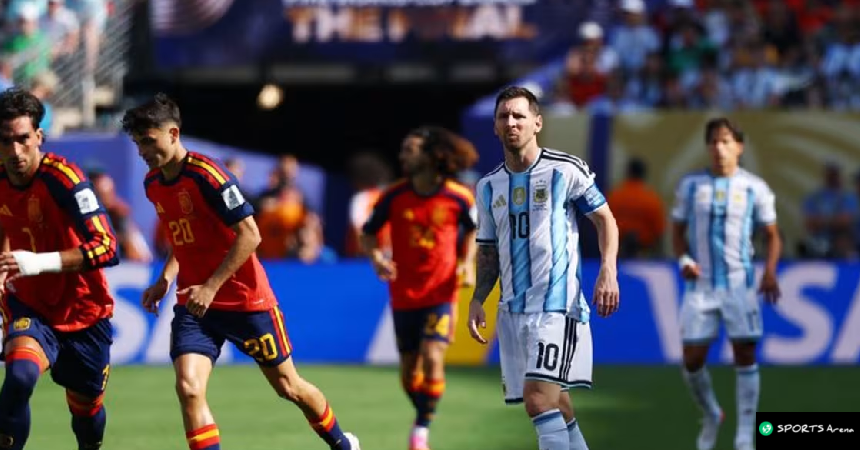
MetLife Stadium was packed with fans in blue and white jerseys. From the opening whistle, Argentina supporters were eager to see Messi lift the World Cup trophy for the second consecutive time. The occasion was made all the more special when 1978 World Cup-winning Argentina captain Mario Kempes held the golden trophy aloft before the match, providing an inspiring moment for Messi and the rest of the squad ahead of the 2026 World Cup final. The spotlight was firmly on Argentina as they arrived at the final with an extraordinary run of results. However, despite being the away team in terms of crowd support, Spain were the dominant force in the first half.
Brazil still hold the record for winning seven consecutive matches in a single World Cup tournament with a 100 percent win rate — a feat achieved by the Ronaldo-Rivaldo-Ronaldinho side at the 2002 World Cup. This is the first time Argentina have reached a World Cup final with seven consecutive victories. It is also the first occasion in World Cup history that the two highest-ranked teams in the FIFA rankings have met in the final. In a match of such pedigree, both sides began cautiously, prioritising defensive solidity and fighting for control of the midfield.
Playing in a 4-4-2 formation, Argentina’s two forwards — Lionel Messi and Julián Álvarez — were rendered virtually ineffective in the first half by the tight and disciplined marking of the Spanish defence.
Spain, by contrast, played their familiar tiki-taka football in a 4-2-3-1 formation, looking to wear down their opponents through prolonged ball retention and quick one-touch passing combinations. Spain dominated possession in the first half, holding 65 percent of the ball and completing 313 passes to Argentina’s 155. Goalkeeper Emiliano Martínez kept Argentina in the game with two excellent saves.
Spain crafted two well-organised attacks in the opening 45 minutes. In the fifth minute, the highly touted Lamine Yamal made a dangerous run into the penalty area from the right flank and laid the ball off to midfielder Dani Olmo, who immediately returned it to Yamal with a perfectly threaded through ball. However, the combined efforts of Lisandro Martínez and goalkeeper Emiliano Martínez prevented any real danger from materialising.
In the 39th minute, another carefully constructed Spain move threatened to break the deadlock. Following a slick combination involving Laporte, Rodri, and Baena, Fabián Ruiz received the ball and played it into the path of Mikel Oyarzabal, who was advancing into the penalty area. Oyarzabal struck a powerful left-footed shot from the edge of the box, but Emiliano Martínez produced a superb leaping save to keep it out.
Messi had just 15 touches of the ball in the first half, yet still managed to create a meaningful opportunity ahead of the hydration break. In the 22nd minute, the Argentina captain released a precise pass to Nicolás González on the edge of the box, but González was unable to bring the ball under control and the chance was lost.
Álvarez was even less involved than Messi. The striker managed only eight touches in the first 45 minutes, a stark contrast to the 26 and 20 recorded by Yamal and Oyarzabal respectively on the Spain side.
Spain midfielder Rodri was ubiquitous throughout the first half, accumulating 57 touches as he dictated play from deep. Argentina found themselves unable to penetrate the defensive wall formed by Cubarsí, Porro, and Laporte. Meanwhile, Spain’s industrious left-back Marc Cucurella repeatedly made overlapping runs down the left flank, providing an additional attacking outlet and offering support to the defensive midfielders.