

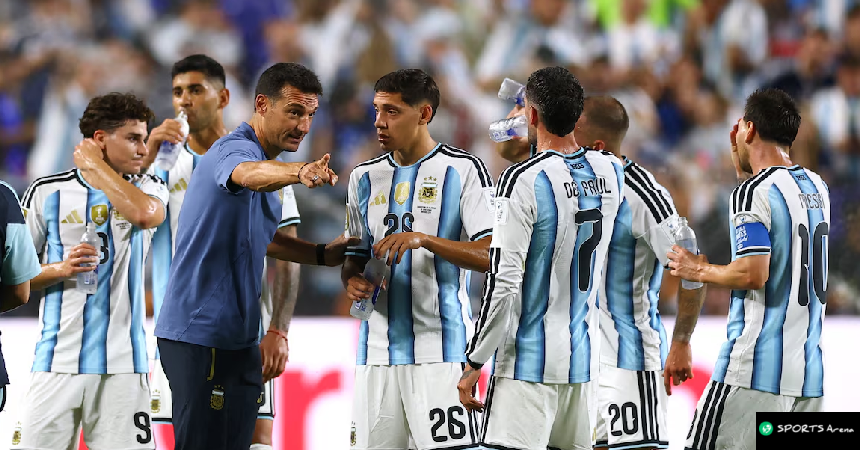
One of the talking points of this year’s World Cup has been the “hydration break.” There has been no shortage of debate about the three-minute water break introduced during matches. The biggest topic of discussion has been how these breaks change the momentum or direction of a team’s play. The short breaks have genuinely altered the course of matches, with the most goals being scored in the moments immediately after the water break ends.
A survey by Brazilian media outlet UOL found that in 40 of the 102 matches at the current World Cup (39.2 percent of the total), goals were scored immediately after a water break, either deciding the outcome of the match or changing its course. The impact of this break becomes even clearer when looking at the overall goal tally: of the 297 goals scored throughout the tournament, 74 came immediately after water breaks — 24.9 percent of the total — with each of those goals having a direct impact on the match.
Regarding the water break, FIFA President Gianni Infantino said, “Perhaps this short break gives coaches a chance to reassess the situation on the field and correct their mistakes. The players also recover a little and return to the pitch with renewed strength. Now the question is, is this really a bad thing? Maybe it’s actually a good decision.”
The FIFA president has indicated he will reconsider whether to keep this rule for future tournaments after analyzing the experience and results.
Argentina and Bosnia: two contrasting stories
Argentina have topped the list for goals scored immediately after a hydration break at the 2026 World Cup. The effectiveness of this tactic was particularly evident in the semi-final against England, as Argentina scored nine crucial goals immediately after breaks across their four knockout matches at the tournament.
The most memorable and thrilling moments of the tournament came in the knockout stages. Argentina were in dire straits after falling behind 2-0 at one point in the quarter-final against Egypt. But after rehydrating during the water break, the Albiceleste seemed to transform. They scored three brilliant goals in the period following the break to snatch an incredible victory.
The semi-final against England told a similar story. The reigning world champions had fallen behind 1-0 early on, but Argentina turned the tables again after the break in the second half, scoring two brilliant goals to win the match and secure their place in the final.
Scaloni criticizes the rule despite benefiting from it
Although Argentina appear to be gaining an advantage under FIFA’s new rule, coach Lionel Scaloni has strongly criticized the hydration break, saying it disrupts the natural rhythm of football.
In Scaloni’s words: “I think a football match is now effectively divided into four quarters. There are three and a half minutes to talk tactics with the players each time. The game plan you go in with can be completely turned upside down by this break after just 22 or 23 minutes of play. Dividing football into four quarters like this is simply unrealistic.”
On the other hand, while Argentina took full advantage of this rule, Bosnia and Herzegovina suffered the most because of it. They conceded three goals immediately after water breaks throughout the tournament and lost matches as a result.
Bosnia conceded goals right after the break in their group-stage draw against Canada and their loss to Switzerland. Then, in their round-of-16 match against the United States, they made the same mistake again, conceding two goals immediately after the break — a moment that ultimately sealed their exit from the tournament.
Ancelotti’s Brazil experience both sides of the rule
Brazil have experienced both the good and the bad of this new World Cup rule. Carlo Ancelotti’s side, who left Real Madrid to take charge of the Brazilian dugout, scored twice in the tournament by capitalizing on the break. The first time the Seleção scored after a break was in their group-stage draw against Morocco. They then came from behind to beat Japan in the second half, a win also aided by a goal scored just after the break.
But Brazil also saw the other side of the coin. The hydration break proved costly in their high-stakes round-of-16 match against Norway. In that match, immediately after the break, Norwegian goal machine Erling Haaland scored twice in quick succession in the final minutes. Haaland’s double sent the Seleção crashing out of the tournament in tears.