







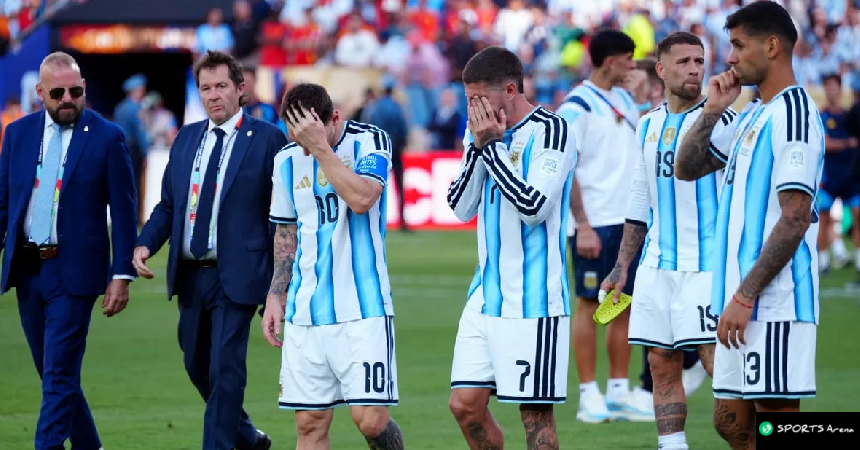
Despite the scoreline reading only 1-0, Spain dominated every inch of the MetLife Stadium pitch across the full 120 minutes. In the end, La Roja defeated ten-man Argentina with a stunning goal from substitute Ferran Torres in the 116th minute to lift the World Cup for the second time. Spain claimed their first title in Johannesburg in 2010, beating the Netherlands with an extra-time goal from Andrés Iniesta — and now, 16 years later, they are world champions once again.
But where did Argentina go wrong? Why did the defending champions, who managed only two shots across the entire match, surrender so helplessly to Luis de la Fuente’s side?
Over-Reliance on Messi
Lionel Messi, who had scored eight goals across the tournament, was completely neutralised by the Spanish defence on the night. His expected goals (xG) value across the entire match was just 0.04, and the superstar failed to create a single key pass. The captain’s inactivity significantly diminished Argentina’s attacking threat and left them with no alternative source of creativity or danger.
Spain’s Midfield Dominance
As had been the case throughout the tournament, the Spanish midfield was supreme in the final. Spain displayed a remarkable ability to circulate the ball quickly and win it back almost immediately after losing it, denying Argentina any opportunity to establish meaningful spells of possession or build attacking momentum.
Lisandro Martínez’s Injury and the Loss of Defensive Balance
The defensive partnership of Cristian Romero and Lisandro Martínez had been the bedrock of Argentina’s strength throughout the tournament. But when Lisandro was forced off injured at the very end of the first half, Scaloni had no choice but to introduce 38-year-old Nicolás Otamendi as his replacement. Lisandro’s ability to step out from the defensive line and carry the ball forward was immediately missed, and Argentina’s defensive shape and balance never fully recovered.
Enzo Fernández’s Red Card and Its Devastating Consequences
Enzo Fernández was dismissed in the third minute of second-half stoppage time, receiving a second yellow card — effectively a red — for a foul on Pau Cubarsí. Facing one of the most efficient and clinical sides in World Cup history — a team that had conceded just one goal in the entire tournament — with only ten men proved an impossible task for Argentina. Spain exploited the numerical advantage to devastating effect in the second period of extra time, with Torres’ precise finish extinguishing Argentina’s dream of back-to-back World Cup glory.
A Complete Drought in Attack
Argentina had been the tournament’s joint-top scorers heading into the final, having netted 19 goals across their seven previous matches. Yet in the final itself, they failed to register a single shot on target across the regulation 90 minutes — and managed only two shots in total across the full 120 minutes. For a team of such attacking pedigree and firepower, it was a stunning and comprehensive failure to create, and ultimately the most telling explanation for their defeat.